Why We Exist
Because most websites were built to talk about the business. Not to help the person standing at the door.
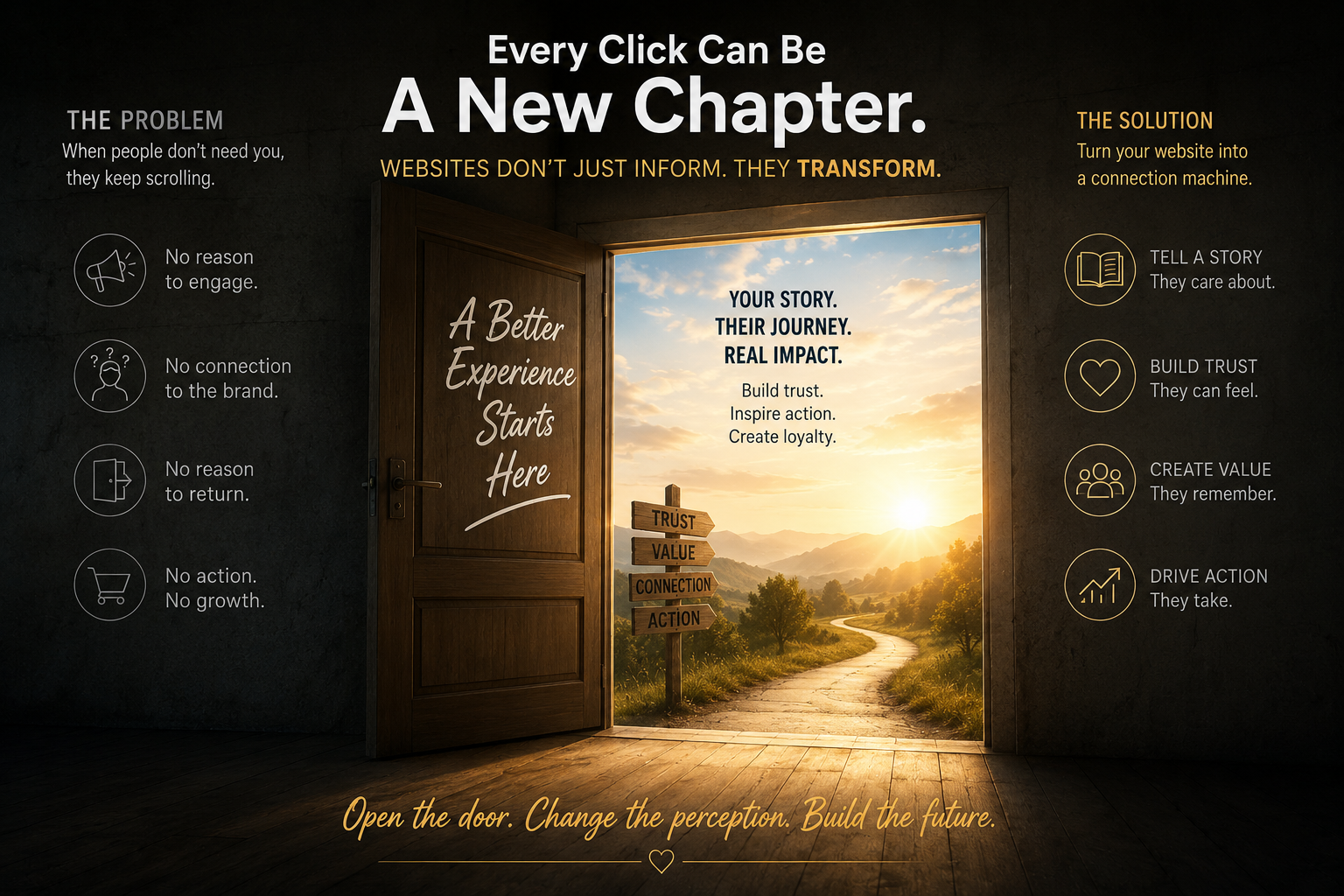
You’ve probably seen website conversion statistics quoted all over the internet.¹
Some studies suggest the average website converts only a small percentage of visitors.²
The exact number isn’t the interesting part.
What caught our attention was something else.
Businesses spend thousands of dollars building websites.
Then they spend more maintaining them.
More improving them.
More protecting them.
More advertising to send people there.
And yet many websites still struggle to turn visitors into meaningful action.³
That was the question we couldn’t stop thinking about.
Then one day we sat down and looked at our own website.
We stared at it.
It stared back.
And we thought: what exactly is this thing supposed to be doing?
Then we started looking at other websites.
And another.
And another.
And another.
That is when we realised something uncomfortable.
The problem was not that websites were broken.
The problem was that many of them were not doing what they were supposed to be doing.
A website can have beautiful design, a clever logo, fast hosting, awards, traffic, and thousands of visitors.
But if it is not helping people take the next step, what exactly is it doing?
That question kept bothering us.
Because businesses spend thousands building websites. Then they spend more maintaining them, improving them, protecting them, and advertising to send people there.
And yet many websites still convert only a tiny percentage of visitors into action.
That is the part we could not stop thinking about.
Not because websites are bad. Because the gap between what they cost and what they achieve can be enormous.
Every website has a different job
Some sell products. Some book appointments. Some raise donations. Some promote artists, events, or ideas. Some simply help people find information.
The job changes.
The question does not.
That is the question we became obsessed with.
The internet has become a shouting match
Most websites do not help people.
They perform for them.
They brag. They waffle. They spend paragraph after paragraph talking about themselves while the visitor is standing there thinking:
Imagine your kitchen is flooding. Water is pouring across the floor. You call an emergency plumber.
He arrives at your front door and spends ten minutes explaining why he won “Best Small Business 2018”.
At some point, you are going to ask a perfectly reasonable question:
Yet that is exactly what many websites do.
People arrive looking for help. The website responds with a brochure.
No wonder people leave.
The problem starts earlier than most people think
Most businesses think their website exists to explain who they are.
We think it exists to help someone decide what to do next.
Those are two very different jobs.
When people arrive on a website, they are usually not looking for a company. They are looking for an answer. A solution. A direction. A next step.
Yet many websites immediately start talking about themselves instead.
It is a bit like calling an ambulance and getting a history lesson about the ambulance service before anyone asks where you are.
The problem is not that businesses care about themselves.
The problem is that the visitor cares about something else first.
We do not build homepages. We build a door.
That is why we do things differently.
We do not want people landing on a website and immediately feeling trapped inside a sales pitch.
We do not want them digging through menus trying to work out where they are supposed to go.
And we certainly do not want them feeling stupid because they do not speak fluent “website”.
So we stopped thinking about homepages.
Instead, we built a door.
A simple way in.
A place that asks one honest question:
- I have got a website.
- I am not sure.
- I have not got one yet.
The script flip
Most contact pages work the same way.
Fill out the form. Wait. Hope someone replies. Hope they actually read what you wrote.
Hope your message has not disappeared into a digital cupboard full of forgotten enquiries and good intentions.
We wanted to flip that script.
When you arrive here, we are not asking you to explain everything. We are asking where you are starting from.
That is the job. Not yours. Ours.
Because if a doctor handed you a clipboard and asked how you planned to diagnose yourself, you would probably find another doctor.
The internet has spent years making people do the work businesses should have been doing.
We are trying to reverse that.
Sources & further reading
Website conversion benchmarks vary by industry, traffic source, and conversion type. The point is not the exact percentage — it is whether the website helps people take the next step.
Benchmarks by industry · Conversion statistics · HubSpot guide
It takes one step to start a journey.
Every website has a different job.
Every visitor has a different destination.
But every journey starts the same way.
With a single step.
The question is: